The Humour Foundation

RESEARCH FINDINGS

Norman Cousins was the first person in recent times to draw attention to the health benefits of humour. This was from his own experience of illness.

William Fry is another that has contributed greatly to the research on the physiological research on humour. Berk and Tan have also done many of the studies on which claims for the physiological benefits of laughter are made. 

Rod Martin 2001 wrote a paper on the limitations of some research claims. It points out the so-called endorphin effect is still questionable.

Pain

Norman Cousins found humour and laughter relieved the pain of his ankylosing spondylitis. In 1969 he collaborated with his physician Dr Hitzig. He watched funny films and read humorous books and found that 10 minutes of laughter gave him 2 hours of pain free sleep. There was physiological evidence in his lower sedimentation rate (a measure of inflammation.) The reduction not only held, but was cumulative. He popularised the benefits of laughter in his books Anatomy of an Illness and Head First: The Biology of Hope.

His theory that positive emotions had a positive effect on health lead to modern research. Based at UCLA Medical School, he established the Humor Research Task Force to co-ordinate and support world wide clinical research on humour.

Other studies also showed that laughter helped reduce pain, although much of this is anecdotal. In 1928 Dr James Walsh noted in his book Laughter and Health that laughter reduced the pain after surgery and promoted wound healing.

Women with painful muscle disorders got significant pain relief after a course of humour therapy. (L. Ljungdahl Journal of the American Medical Association 1989)

Young girls with burns were shown cartoons during very painful hydrotherapy. Their perception of pain was reduced. The study was done by ML Kelly and published in the Journal of Applied Behaviour Analysis 1984)

Cardiovascular

Laughter, like exercise, reduces the heart rate. William Fry in 1971 first demonstrated that laughter increases the heart rate, blood pressure, oxygen consumption, and works the muscles in the face and stomach. Shortly after, these levels drop, providing a relaxation response.

Stress

Prolonged stress creates unhealthy physiological changes. Stress causes the adrenal glands to release cortico steroids and high levels have an immunosuppressive effect. Laughter is an antidote. Berk, Tan, Fry et al reported this in Neuroendrocrine and stress hormone changes during mirthful laughter American Journal of the Medical Sciences. 298(6), 390-396.

Immune System

Laughter stimulates the immune system. L. Berk, of Loma Linda University School of Medicine  demonstrated that laughter

•     lowers serum cortisol levels
•     increases the number of T-cells that have helper/suppressor receptors 
•     increases the number & activity of natural killer cells

Other research supported these findings.

Blood of patients was analysed before, during and after watching a humorous video. The test found ´significant´ boost to immune function, including higher levels of anti-bodies and natural killer cells which are the body´s defence against aberrant cells such as cancer. Thi s study was done by  Barry Bittman, neurologist & pioneer in psychoneuroimmunology (how emotions effect the immune system)

The positive effects of laughter on the immune system continued the next day - - - levels of Plasma Immunoglobulin, Plasma Cytokine Gamma Interferon and killer cells remained high 12 hours later. Berk /Tan published this study in Laughter & The Immune System: a serious approach

Respiratory System

Dr David Garlick of University of NSW School of Physiology & Pharmacology studies the effects of laughter on the respiratory system. Abdominal movements were measured during funny videos and documentaries. Laughter was followed by a long sigh and a large intake of breath, leading to better respiratory movement.

Clowns for the prevention of preoperative anxiety in children: a randomized controlled trial.

Department of Anesthesia and Intensive Care, Sheba Medical Center, Tel Aviv University, Tel Aviv, Israel.

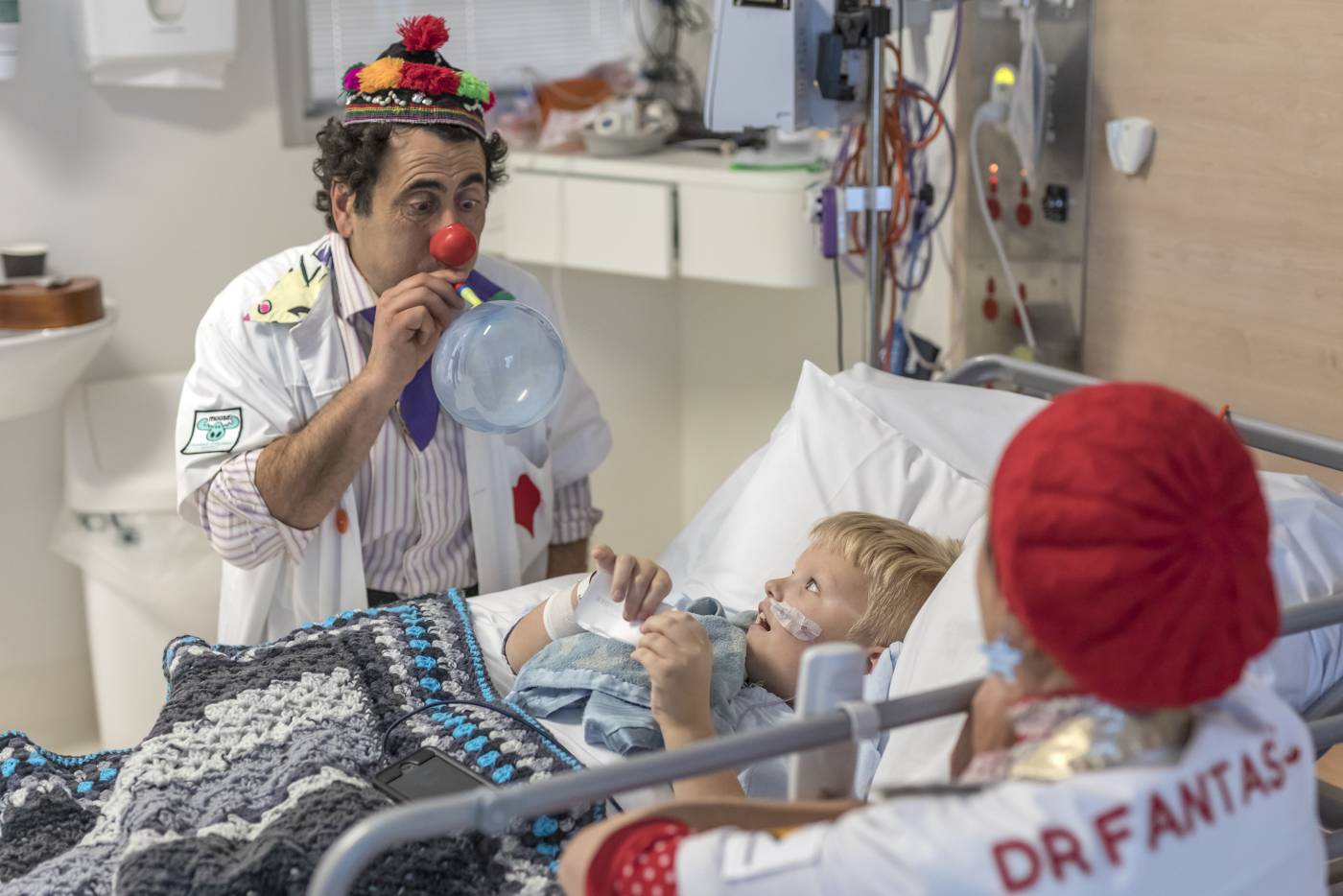
OBJECTIVE: To determine if specially trained professional clowns allayed preoperative anxiety and

resulted in a smooth anesthetic induction compared to the use of midazolam or no intervention.


METHODS: This was a randomized, controlled, and blinded study conducted with children 3-8 years of age undergoing general anesthesia and elective outpatient surgery. Patients were assigned to one of three groups: Group 1 did not receive midazolam or clown presence; group 2 received 0.5 mg x kg(-1) oral midazolam 30 min before surgery up to a maximum of 15 mg; and group 3 had two specially trained clowns present upon arrival to the preoperative holding area and throughout operating room (OR) entrance and mask application for inhalation induction of anesthesia. The children were videotaped for later grading. RESULTS: The clown group had a statistically significant lower modified-Yale Preoperative Anxiety Scale score in the preoperative holding area compared to the control and midazolam group. The clowns´ effect on anxiety reduction continued when the children entered the OR but was equal at this point to the midazolam group. Upon application of the anesthesia mask no significant differences were detected between the groups.


CONCLUSIONS: This study found that the use of preoperative medically trained clowns for children undergoing surgery can significantly alleviate preoperative anxiety. However, clowns do not have any effect once the anesthesia mask is introduced.

http://www.ncbi.nlm.nih.gov/pubmed/19143948


Patch Adams


Patch Adams may have years of experience entertaining kids in various hospitals, but he’s not a certified medical clown. He does, though, probably deserve an honorary degree from Haifa University in Israel which just announced a new three year academic program in medical clowning.  Developed with the Magi Foundation, the so-called Dream Doctors program will graduate the world’s first formally taught and qualified entertainers specifically for clinical situations.
http://www.impactlab.com/2009/11/28/dream-doctors-program-will-graduate-worlds-first-medical-clowns/

STUDYING BURNOUT IN CLOWN DOCTORS
http://books.google.com/books?id=xbt1n1rYgrQC&pg=PT187&lpg=PT187&dq=%22Clown+Doctors%22&source=bl&ots=1gK2UtSvrb&sig=KtMGR4T3gt6nNfwpnSxUkimVEq8&hl=en#v=onepage&q=%22Clown%20Doctors%22&f=false

non-pharmological interventions for assisting anaesthesia in childreN
Click here for more...

Clown Doctors as treatment for pre-operative anxiety in children
Click here for more...

Donations 

ABAF Award

The Australian Business Arts Foundation Awards recognise innovative and beneficial arts-corporate relationships.

For the second year running we are proud to have won an ABAF ‘Good Practice in Partnering’ award for our partnership with Cadbury Schweppes in Tasmania.